
The Dutch public prosecution service department is conducting a preliminary fact-finding investigation into forgery (Art. 225 Sr) and witness intimidation (Art. 285a Sr) by high-ranking D66 officials. The suspicion of these offenses has been raised by the deliberate manipulation of documents and regulations with the intent to feign a procedural reality, in order to retroactively justify a rule – invented on the spot at Congress 122 to stifle a politically inconvenient perspective.
This longread delves into the background, the development, the discovery, and the aftermath of these events. It begins with the background. For the incident that led to the (potential) forgery, you can scroll down to the section Schrödinger’s house rules. The commission of the offenses is discussed in A document intended to serve as proof of any fact.
I could argue that this drama began with a flyer at Congress 122. But that would do an injustice to reality. This story begins with a girl, on May 20, 2006, in Idlib, Syria. There, a defiant girl was born who would harbor a deep longing for freedom. After the outbreak of the civil war, she and her family found safety, and above all: freedom, in our country. Her desire for freedom, however, was not appreciated within the family.
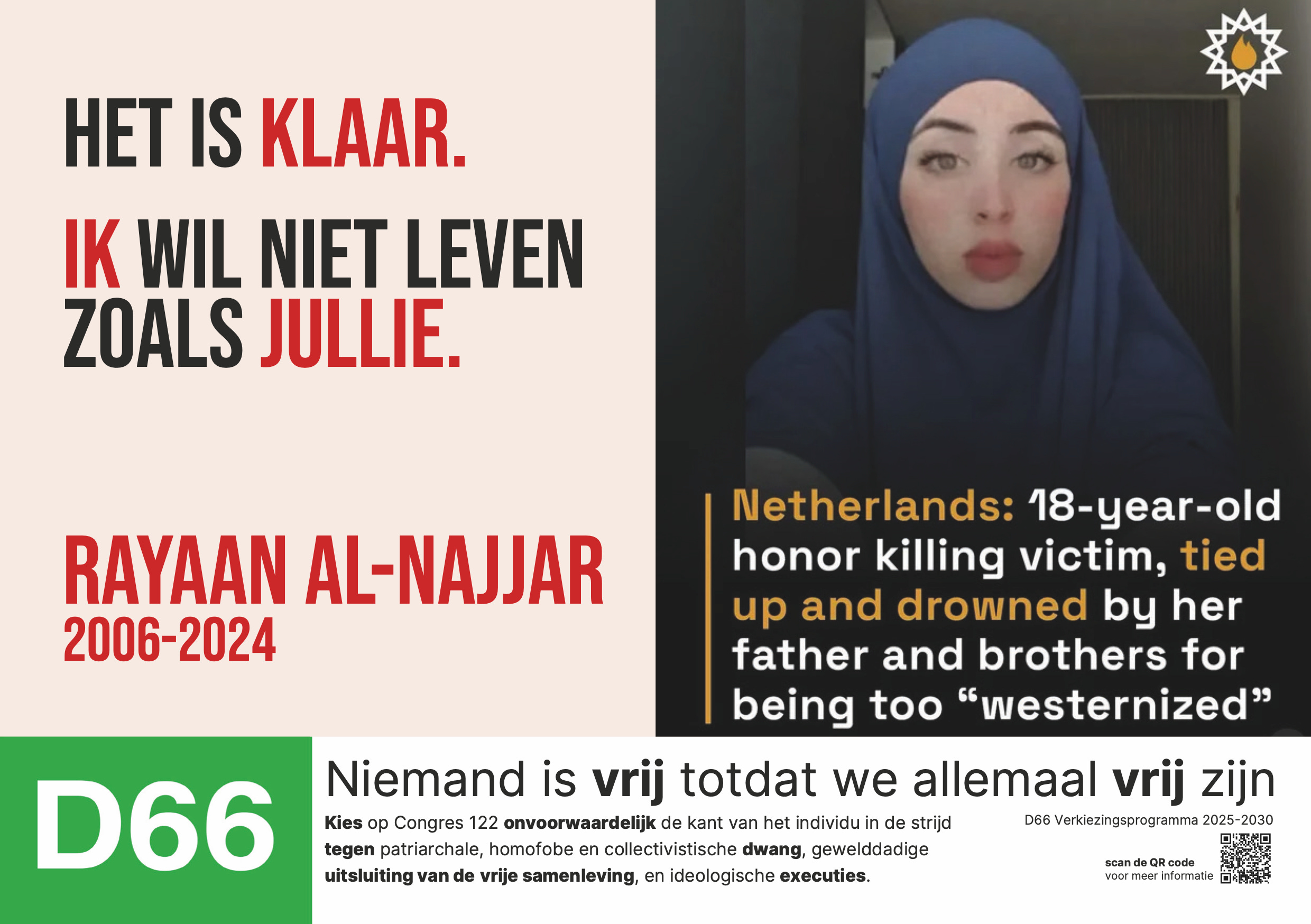
Already at the age of fourteen, she fled barefoot in the winter cold, wearing a pink tracksuit, to the neighbors, because her father had threatened to murder her. After years of violence, interventions by child protective services, and above all: loneliness, it culminated in the words: I am done, I do not want to live like you. A few days later, during the night of May 27 to 28, 2024, she was executed by her father and brothers. Her name was: Rayaan al-Najjar. We do not know much more about her. The pieces of her father’s skin that detectives found under her fingernails tell us, at the very least, that Rayaan fought for her freedom until her dying breath.
Not everyone who longs for freedom and happens to have ancestors born abroad ends up with duct tape over her mouth in a filthy marsh in the polder. More often, the free individual, made into a Muslim, develops all sorts of strategies to cope with this (verbal, psychological, or physical) violence. I know very few women (and gay men) who have not fallen victim to ideological violence or adapted their behavior to avoid it. This ideological violence goes by many names—honor-related, forced marriage (systematic rape), or abandonment (forced emigration)—but they all share the fact that they target the individual who refuses to conform to the role allegedly ordained by God, according to the patriarchs. It is ideologically motivated violence.
Stop violence against white women
Progressives hate the patriarchy. So does D66, noble house of the Enlightenment. After a seventeen-year-old girl from Abcoude was killed—entirely at random—while cycling home, the discussion about femicide flared up again. I wrote an op-ed about it in De Volkskrant: The conversation about femicide is institutionally racist. The central question of this op-ed was why the polder feminists see the death of a white hockey girl as a reason to elevate her as a national symbol, yet completely ignore a woman who, after a years-long struggle over her own body and mind, was executed by her father and brothers.
Following the op-ed, I was also invited to the Volkskrant podcast Culturele Bagage (Cultural Baggage) to discuss this, within the context of the broader theme that violence against women is also a men’s issue. With host Esma Linnemann, I delve deeper into the statistics. At the end of the conversation, Linnemann asks if I have any concrete tips for men. Earlier in the conversation, we had already touched upon the importance of reflecting on the language one uses, and especially the assumptions embedded in that language. Although I consider sharing one of my usual conversational techniques—namely, asking men why their “honor” is dependent on what their mother or sister does with her vagina—I opt for a safer example. “But,” I say, “I think we sometimes also need the brutal boot of the state.”
That brutal boot of the state (which I would later rename the fist of freedom) declared slavery and apartheid to be crimes against humanity. Likewise, the underlying systems that drive violence against women must be designated as crimes against humanity. “The patriarchy,” Linnemann adds. After all, the recognition of slavery and apartheid as crimes against humanity ultimately also started with just an individual with an idea. What is the most obvious place to plant the seed for this idea? D66.
At the new members’ day of D66, I had already brought this up at the Els Borst Network (EBN), the women’s network of D66. At the gathering—held, I believe, in the Aletta Jacobs room of the House of Representatives of all places—there was a handful of men, and the moderators subsequently asked them what motivated them to be present there as men. As far as I can remember, the other men had a standard story about how sad it is that their girlfriend isn’t treated equally, or something to that effect. I said: “I am here to discuss the idea that the patriarchy, as a socio-legal system, is a crime against humanity and that D66 must lay the foundation for this in international law.”
Afterwards, I also pitched it to the chair of the EBN. She immediately thought of Islam and wondered how this idea would relate to the freedom of religion. In any case, we agreed that Islam is an intrinsically patriarchal system. The question of which freedom carries more weight, however—that of religion or that of the defiant woman who refuses to conform to the patriarchy—remained unanswered. I went home wondering what Aletta Jacobs would think about that.
On September 11, 2025, D66 submitted the initiative memorandum Stop Violence Against Women. It contains various proposals to improve the institutional protection of women, such as a broader mandate to intervene behind closed doors and better legal protection. Remarkably, there is no mention of measures against ideologically motivated forms of violence. As I wrote in the op-ed:
A women’s shelter can protect you from a stalking ex, but it is not a fortress against an ideology. This blind spot leaves women, primarily those with a migration background, completely out in the cold. If you want a concrete example of what this can lead to, I refer you to [Rayaan] al-Najjar. She was actually receiving security protection, but at a certain point, it was discontinued. Had her threateners experienced new revelations? Had they rejected their oppressive ideology?
D66 previously drafted the Action Plan Against Femicide. In it, the authors state that femicide is often dismissed as “honor killing,” as if executing a woman for ideological reasons would somehow trivialize the severity of the act. Yet, this document too lacks concrete policy measures to combat ideologically motivated violence against women and sexual minorities of color. Apparently, a blind spot for this violence emerged within D66 during the rise to dominance of the Pechtold-Kaag-Jetten dynasty. In the distant past, under the leadership of Boris Dittrich, D66 actually advocated for harsh measures, such as revoking residence permits or even Dutch citizenship.
Most political parties in the Netherlands are associations, and so is D66. According to Dutch law, an association has a General Assembly, a gathering of the voting members, which constitutes the highest governing body of the association. In a functioning associational democracy, members thus exert influence on the course of the party. Removing D66’s blind spot regarding ideologically motivated violence against women and sexual minorities of color could therefore be achieved simply: with a resolution by the General Assembly of D66.
The General Assembly of D66 declares that
Just as in parliament, Dutch political parties vote on motions at their General Assembly. A motion within D66 consists of three parts. The first part is the observations. These are the facts that prompted the motion. The second part is the considerations. The considerations are the arguments that must support the third part, the operative part. The operative part is the binding section of the motion, which can be, for example, a statement of principle (declares that) or a call to a party body or the parliamentary group (calls upon the National Board to, calls upon the parliamentary group in the House of Representatives to). Ultimately, the motion takes the form: The General Assembly of D66 [...] observes [...] considers [...] calls upon/declares that [...] and proceeds to the order of the day. If a majority of the members vote in favor of the motion, the operative part is binding for the association.
In the summer of 2025, the Amsterdam branch of D66 organized a meeting on femicide. There, too, ideologically motivated violence was not discussed—although a drone once literally flew around in Amsterdam to check whether girls were behaving ‘halal’ enough at a festival—yet the meeting bore fruit nonetheless. I spoke with a member there, with whom I discussed my idea to declare gender apartheid a crime against humanity. She pointed me to the Istanbul Convention, an international treaty aimed at eradicating violence against women. Article 12 of the treaty states:
The parties shall take the necessary measures to [...] eradicate all ... practices based on the idea of the inferiority of women or on stereotyped roles for women and men [...] The parties shall ensure that culture, custom, religion, tradition or so-called “honor” are not used as justification for acts of violence that fall within the scope of this Convention.
Apparently, D66 thus also produces initiative memoranda and action plans that are in conflict with international law, or at least negligent in its implementation, particularly negligent in the sections relating to women of color. Armed with this knowledge, I therefore drafted a motion for the 122nd General Assembly of D66 to correct the party’s course in this regard. Initially, these were three motions, but the Decision-Making Committee (Besluitvormingscommissie) decided that I had to merge them into a single motion. The final text thus became:
The General Assembly of D66, convened on Saturday, October 4, 2025, in ‘s-Hertogenbosch [...] declares that:
D66, in the struggle of the individual against patriarchal, homophobic, and collectivistic norms, unconditionally takes the side of the individual
patriarchal views must be combated unconditionally, and without distinction as to cultural or religious origin
calls upon the parliamentary group in the House of Representatives to:
in the practice of politics, support the emancipation struggle of girls and women with a migration background, and by extension sexual minorities and dissidents, in word and deed, explicitly during the creation of policy regarding femicide and the safety of women
weigh ideologically motivated violence against people who wish to participate in the free society with the same severity as political violence.
The full text of the motion can be read here, and it would receive the designation APM122.01. For the 122nd General Assembly, other members had also submitted a number of amendments to the election program, including proposals to more strictly monitor religious education. To inform the members of D66 about the severity of ideologically motivated violence against women and sexual minorities of color, I therefore designed a flyer. Once the D66 members were made aware of the gravity of this issue, surely they would opt for a more secular course and choose better measures to ensure that freedom is for everyone, and not just for white people.
Through court reporter Saskia Belleman, I had learned that shortly before her father and brothers executed her, Rayaan made it known to them that she was done with it and no longer wanted to live like them. Therefore, I placed those words on the front of the flyer: “I am done. I do not want to live like you anymore. Ryan al-Najjar (2006-2024)”. On the right side, I placed her portrait—where she was still wearing the headscarf that she would take off just around the corner after leaving her parental home—because this was the only image of her I could find. Rayaan should, after all, be a typical D66 heroine, as a woman who fought for years to gain control over her own life. Who else should be on the cover of a D66 flyer on this topic? Lisa from Abcoude? The fact that Rayaan did not bow to oppression and fought against it to her last breath, makes adorning the front of a flyer about freedom with her unyielding words the very least tribute we can pay her.
On the back of the flyer, I placed statistics about ideologically motivated violence against women and sexual minorities of color. I wrote underneath it:
This is not a “strange” or “cultural” phenomenon. It is ideologically motivated violence that is of the same severity as political violence. The absence of a comprehensive approach in government policy is a form of institutional racism.
On the right side of the back, I placed a political-ideological text to provide context for Rayaan and the figures. “D66 has traditionally stood at the forefront of the struggle for the emancipation of the individual,” I wrote, “A hundred and fifty years after Aletta Jacobs, the ambition to become a doctor is still being murdered because chaste daughters are not supposed to take the bus in the dark.”
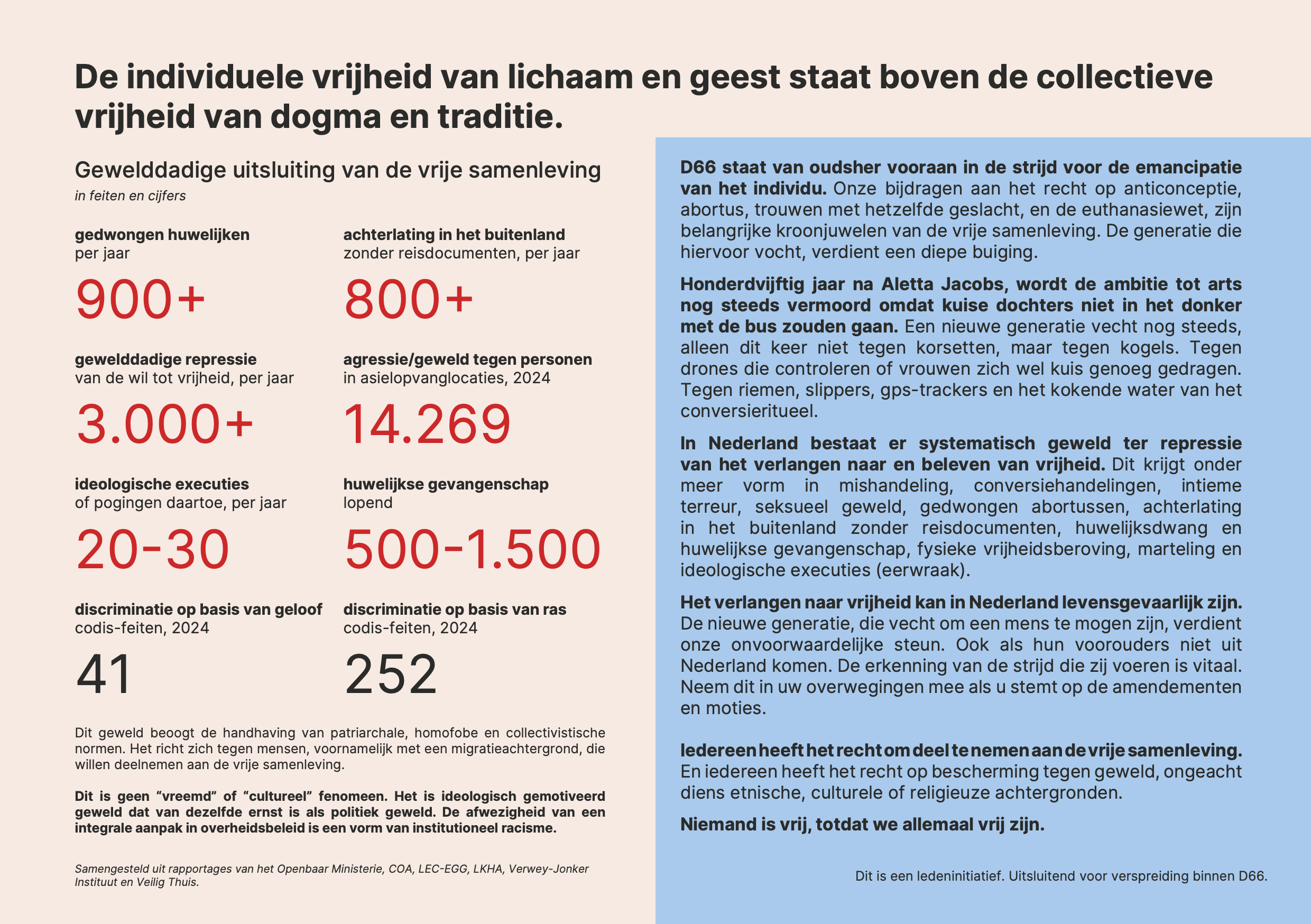
To finish it off, I took the logo from the D66 website, a quote from the draft election program, and made sure that the font and colors matched the usual layout of D66 flyers. Next, I commissioned a printing company to deliver five hundred copies. I sent a digital version to the D66 parliamentary group.
I also consulted the D66 website to check the regulations. There were no house rules listed, but there was a page with rules specifically for Congress 122 on October 4, 2025. It also included a rule about handing out flyers, under the question May I hand out flyers at the congress?:
At the congress, you may hand out D66-related flyers. Ensure that the flyers look neat and presentable in the D66 house style, so that everyone can see they are from D66. Do you have any questions or doubts? Contact us via congres@d66.nl
In any case, the flyer unambiguously stated that it was a member initiative and intended exclusively for distribution within D66. I had no doubts about the house style, as it was based on the D66 website and previous flyers. Insofar as such doubt could exist, Article 6:238, paragraph 2 of the Dutch Civil Code (BW) resolved it: “In case of doubt about the meaning of a clause, the interpretation most favorable to the other party prevails.” Who is the other party in the context of these congress rules? The congress attendee. In other words: myself.
Armed with the Civil Code, the D66 congress rules, and five hundred flyers, I booked a hotel in the center of Den Bosch for the night of October 3 to 4, 2025. I usually do this when I go to a D66 congress, because even though they always take place on Saturdays, the congress organization insists on starting at half past nine in the morning. Before I go to sleep, I lay out my belt, my tie, my dark blue jacket, and my dark blue trousers on one of the beds in the hotel room. I rarely do that, but since I am allowed to address the General Assembly of D66 with an opening and a closing statement during the consideration of my motion APM122.01, I cannot afford to be late.
Around half past four in the morning, a loud chanting wakes me up. “Together we burn the Jews, because Jews burn the best,” echoes off the walls of the Hinthamerstraat in the Municipality of ‘s-Hertogenbosch. “Sieg heil,” the choir continues, “sieg heil, sieg heil!” A rainy Saturday morning in the land of Spinoza, prior to the 122nd D66 congress, where we will undoubtedly listen attentively to a highly unifying speech by the party leader. Perhaps this discrepancy between reality and the administrative bubble was a harbinger of what was yet to come.
Schrödinger’s house rules
On the morning of October 4, 2025, even before nine o’clock, I stand at the reception of the 122nd D66 congress, Congress 122, along with a box containing five hundred flyers. I had almost been locked out of the General Assembly where I myself was the spokesperson for a motion, because a technical glitch prevented me from buying a congress ticket. The National Office, acting as the congress organization, could not assist me any further and suggested that I could watch the assembly via the livestream. They did not respond to the question of how I was supposed to take the floor for my motion then. Fortunately, I was able to take over a ticket from another member, whom I reimbursed, thus securing my access to the congress.
After receiving a wristband—even though hand stamps are more sustainable (but more common), the congress organization consistently prefers wristbands—I walk straight to the coffee machines. Not to drink coffee, but to leave my flyers there. Unlike the other congress attendees, who leisurely stroll into the Brabanthallen, I get straight to work. The only other activity comes from the members of the thematic branches, who are setting up their booths in the central hall. In that central hall—the Catering Square, as D66 calls it—there are also standing tables. On these lies the well-known “It can be done” flyer, which D66 used during the election campaign. Because it can be done, I place my own flyers next to them, which leads to the rather peculiar composition: “I am done. I do not want to live like you. It can be done.”
Next, I walk to the plenary hall—the meeting room where the General Assembly convenes. Along the way, I come across another room where a screen is hanging to follow the livestream, which also contains standing tables, where I naturally leave flyers as well. Then I walk further, to the front rows of seats, to place the flyers there too. A flyer on a seat offers a one hundred percent guarantee that it will be seen. I had initially hesitated about this, but because I had discussed the idea a few days earlier with a couple of local board members and a district committee member, who thought it was a great plan, there was no longer any doubt at the congress itself.
While I am almost finished with the second row, a gentleman approaches me. He introduces himself as the Event Manager. He casts a glance at the stack of flyers I am holding and asks me to hold off on placing the flyers on the seats for a moment. Because he does not know if it is allowed, he goes to consult with “Sabine”. I do not know who Sabine is, but I assume she is his supervisor. When he returns, the Event Manager asks if I would please remove the flyers from the seats. I try to negotiate with him, but he says that if he makes an exception, he would have to do it for everyone. As the Dutch saying goes: you already have a “no,” but you might just get a “yes.” This time, it remained a “no.” Subsequently, I comply with his request and take the flyers off the seats.
After collecting the flyers again, I walk ten minutes later toward the entrance of the plenary hall, where the congress attendees are streaming through. If there is a perfect location to hand out flyers, that is it. On my way there, a figure cuts me off. As she does so, three men surround me, including the Event Manager. She stands so close that I can feel her breath. With some discomfort and disorientation, I shake her hand—clumsily, because normally you offer a hand with an extended arm, but that is impossible because she is standing so close. “Sabine Andeweg, director of the National Office,” she says. “Izzy,” I say.
She asks me to stop handing out the flyers. I ask why. Because it is not allowed. I say that the D66 website states that it is. That is not true, says the director of the National Office. Then I take out my phone, visit the page with the rules for Congress 122, and together we read the text:
At the congress, you may hand out D66-related flyers. Ensure that the flyers look neat and presentable in the D66 house style, so that everyone can see they are from D66. Do you have any questions or doubts? Contact us via congres@d66.nl
While looking at the screen of my phone, the director of the National Office says that I should have asked for permission first to hand out my flyers. I say that this is not the gist of the text, and that you only need to email if you have questions or doubts. The director says that I should have emailed. I say that I had no doubts. Without responding to that, the director says that the house style is incorrect and that the old D66 logo is allegedly on the flyer. Even though the logo comes from the website, she does not specify how this logo essentially differs from the supposed new logo. Then the director remarks that the slogan “no one is free until we are all free” is not from D66. I say that it comes from the draft election program we are voting on today. Clearly, there is a stalemate between me and the director of the D66 National Office.
Therefore, I make it unambiguously clear to her that I consider her decision arbitrary and unlawful. So I do not intend to stop handing out the flyers, unless the director can demonstrate that there is a regulatory basis for this measure. She indicates she is going to consult [with someone] and then disappears, but not without explicitly stating once again that I am not allowed to hand out the flyers. The Event Manager disappears with her. I put the box of flyers on a standing table next to the entrance of the plenary hall and lean against it semi-nonchalantly. While I stand there waiting, the two remaining men watch me closely. Because this makes me feel quite uncomfortable, I nervously grab a flyer from the box to distract myself. “Don’t hand out the flyer,” one of the men admonishes. I put the flyer back in the box and try to distract myself with the question: with whom does the director of the National Office, the highest official of the congress organization, need to consult regarding her own decision?
When the director of the D66 National Office returns, she says that I may hand out the flyer until the consideration of my motion, APM122.01. I consider asking how the permission to hand out flyers suddenly changes from “must be requested in advance” to “is tied to an agenda item,” but given the intimidating atmosphere, I choose wisdom over resistance. I fear that if I persist or resist, she will call security. Therefore, I cooperate with this. She also indicates that I must remove the flyers from the standing tables in the area next to the plenary hall, with which I comply. While I clear away the flyers, the two men watch me closely.
My motion will be considered in about fifteen minutes, so I take the opportunity to hand out as many flyers as possible. In any case, Jan Paternotte—now parliamentary leader of the D66 faction—receives the flyer with a smile. The other congress attendees make no objections either. Then the moment arrives for my motion to be considered by the General Assembly of D66.
At the General Assembly of D66, it is customary that during the consideration of a motion or an amendment, the presidium asks if anyone wishes to debate it. If no one wishes to debate, a vote is taken immediately. I had already taken a seat in one of the front rows, right next to the speaker’s microphone. The presidium itself sits on the congress stage at a wide table, usually three people, who then scan the room with their eyes to determine this. This was also the case during the consideration of my motion. “If a debate is desired, then we will have a conversation about it,” the presidium asks. I already stand up, in anticipation of the question whether anyone desires a debate. “I do not see that a debate is desired, so I think we can proceed to the vote.” Somewhat taken aback, I sit back down, as I have no desire for a second conflict. The vote follows. The motion is adopted with 97% of the votes.
After the vote, I remain seated for the consideration of the amendments. Suddenly, a hand appears from behind my back, holding a stack of flyers in front of my face. I look up to see whose hand this is. It turns out to be one of the men from Sabine Andeweg’s posse. He asks if I would tell my “friends from the thematic branch” to stop handing out the flyers. “Yes, fine,” I say, even though I have absolutely no idea what he means by that. I take the flyers, put them back in the box, and turn my attention back to the amendments.
Later that day, my phone’s battery starts running low. The voting takes place digitally, so I walk back to the reception to ask where I can charge my phone. Then, suddenly, the director of the National Office appears, who tells me that it is not the intention for me to be talking to all sorts of people. I have no energy left to ask what she means by this now, and so I just go charge my phone in my car in the parking lot. Even though Rob Jetten, in his unifying speech later that day, would declaim with all his positive energy that it can be done, and the members undoubtedly chanted this along with him, I nonetheless go home afterwards with the feeling that something cannot be done.
A document intended to serve as proof of any fact
If Rayaan al-Najjar did not bow to the executioners who put her to death because of her longing for freedom, then I will certainly not bow to Sabine Andeweg and her posse. After Congress 122, I was furious. Sabine Andeweg’s arguments of convenience and motivated reasoning made it clear even then that this was not about a trivial procedural violation.
What kind of procedural violation does an experienced administrator enforce with an entourage of three men? What ultimate decision-maker goes to consult [others] to backtrack on her own decision? Which D66 regulation states that members are not allowed to talk to others at D66 congresses? The fact that D66 officials apparently invent rules on the spot to erase perspectives that are inconvenient to them is completely contrary to what D66 claims to stand for. Of all things, it lectures the Party for Freedom for having no members, and even wants to amend the Political Parties Act for that purpose. But what is the point of having members, if the establishment treats members this way?
And above all: it wasn't just any flyer. It was an homage to the heroism of a woman who died because she laid claim to freedoms that are sacred to D66. In fact, Sabine Andeweg, director of the National Office, posthumously finished the work of Rayaan's executioners at Congress 122, namely the erasure of her autonomy. Her words, which were on the front of the flyer, were the direct reason for her father and brothers to leave her behind in the Oostvaardersplassen with duct tape over her mouth, so that these criminal words of freedom would never be spoken again. Apparently, Sabine Andeweg wanted to smother these words as well. Or the yet-to-be-identified third parties who instructed her to do so. Therefore, this could not remain without consequences. N.B. this is a hyperbolic and polemical interpretation that has a sufficient factual basis and thus enjoys the protection of Article 10 of the ECHR (European Convention on Human Rights).
To enforce those consequences, I had two options. The first was a procedure at the Dispute Resolution Committee (Geschillencollege), the internal court of D66. Not that I had much confidence in it, as it had previously covered up the fact that the Decision-Making Committee rejected an amendment using a rule invented on the spot. This amendment was about D66’s stance against conversion practices. Because the current stance mainly focused on providers in a professional capacity, which is characteristic of conversion practices in the white, Christian sphere, I wanted to expand it to the informal sphere, specifically by combating “devil or jinn exorcisms.” The Decision-Making Committee defended itself with the argument that, in practice, it also applied rules other than those stated in its formal regulations, which the Dispute Resolution Committee apparently found justified. Whether the Dispute Resolution Committee would judge differently regarding the measure invented on the spot at Congress 122 was already doubtful at that time.
The second option was journalism. In October 2025, I was a Sunday guest columnist for De Volkskrant. My direct contact with the opinion desk also meant that the line to the political desk was very short. The story that a white, elitist D66 official invented a rule on the spot to forbid a member with a migration background from informing D66 members about systematic violence against women and sexual minorities with a migration background, was a scandal in itself. And because of the upcoming elections on October 29, 2025: highly relevant for making an informed choice regarding D66. This was undeniably also known to the D66 establishment, because prior to Congress 122, I had sent an op-ed about motion APM122.01 to the communications department and the National Board of D66, mentioning alongside it that I intended to publish it in a national daily newspaper.
For both routes, I had to gather the evidence. Certainly when publishing a column, which generally faces less strict journalistic criteria, there had to be factual material to substantiate the claims. The absolute, central piece of evidence in this was the page with rules for Congress 122, where it stated that handing out flyers at D66 congresses is allowed, as long as it is clear that they are intended for D66. Therefore, on Saturday, October 11, 2025, I revisited the D66 website to view the page with rules for Congress 122 (archive.org), which I had also looked at together with Sabine Andeweg a week earlier. And what happened then, no one expected.
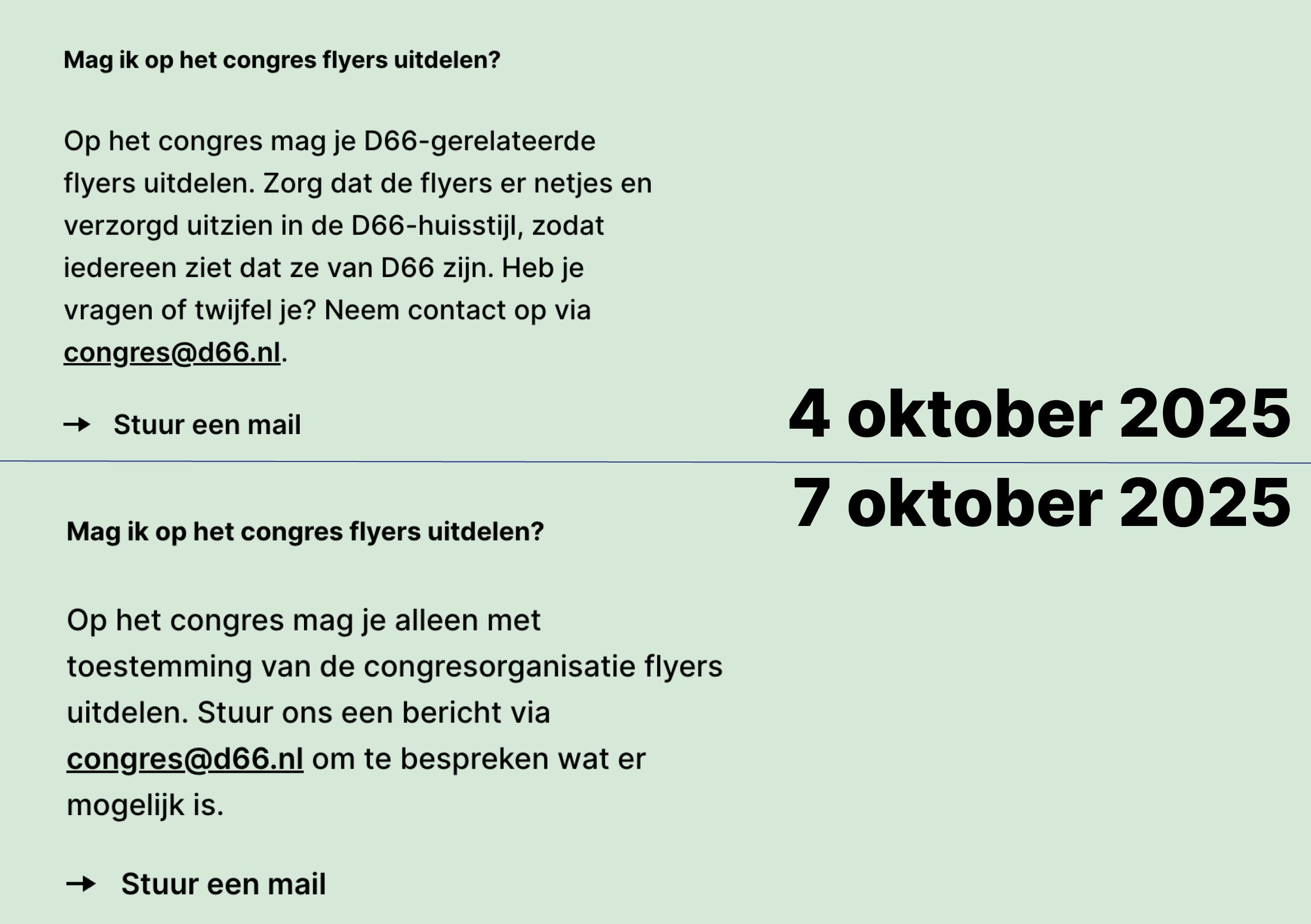
I stare at my screen for a moment. The page with rules for Congress 122 now states that permission from the congress organization is required to hand out flyers (archive.org). The page still otherwise refers to Congress 122 and the Brabanthallen in Den Bosch, even though the next congress is in Nieuwegein. There are practically no other changes. Nor does it mention that the text was altered or what the previous version said. The webpage’s metadata reveals that the last modification was made on October 7, 2025—the second working day after Congress 122. Prompted by this, I send an email to the National Office, which manages the D66 website:
On the frequently asked questions page for Congress 122, under “May I hand out flyers at the congress?”, it states the following: “At the congress, you may only hand out flyers with permission from the congress organization. Send us a message via congres@d66.nl to discuss what is possible.” However, I seem to recall that a different text was here. Could you please email me the previous version?
I am left with the observation that it is remarkable that a text, which a week earlier was at the center of a regulatory conflict, suddenly changes to a version that justifies the decision of the director of the National Office.
On Monday, I receive an email back from the Event Manager. He states that there are house rules that everyone agrees to when purchasing a ticket. I have bought congress tickets before where this was not the case, and it was not required for the upcoming Congress 123 either. Apparently, a one-time exception was made for Congress 122. He also states that in the event of “conflicting information,” these house rules always take precedence. Therefore, the text on the website was modified to “prevent confusion” and to make it “consistent” with the house rules. Which house rules he is referring to I do not know, as they are not on the website, he does not quote from them, nor does he include a hyperlink to a document. Fortunately, he did make a one-time exception for me at Congress 122 after a “constructive conversation.” I send a reply email with additional questions and repeat the request to provide the previous version of the text.
I do not receive a timely response to this. Because in journalism the rule is that what is not current is not relevant, I send a letter to party leader Rob Jetten on October 18, 2025, via Registered Email (Aangetekend Mailen). This is a legally binding system where the recipient receives a notification and can only view the content by explicitly choosing to accept it. In the subject line I write, “Confidential: Procedural request for information regarding Congress 122.” The letter itself opens with the usual pleasantries, a description of the incident at Congress 122, a number of questions about it, and a request to handle the contents of the letter discreetly:
Because it cannot be ruled out that members or staff of the National Board or National Office were involved in this, I request that you and the members of the parliamentary group do not communicate with the National Board or the National Office about this. This could potentially influence the procedures and/or lead to the tampering with evidence. There are indications that the latter has already occurred. Furthermore, the events at Congress 122 have compromised my sense of safety within the party.
Naturally, I conclude the letter with a word of thanks for his dedication and leadership during the election campaign, the strong results, and I wish him success in the final days leading up to the elections. Rob Jetten will never retrieve the contents, and the registered email expires on November 3, 2025, after two automatic reminders.
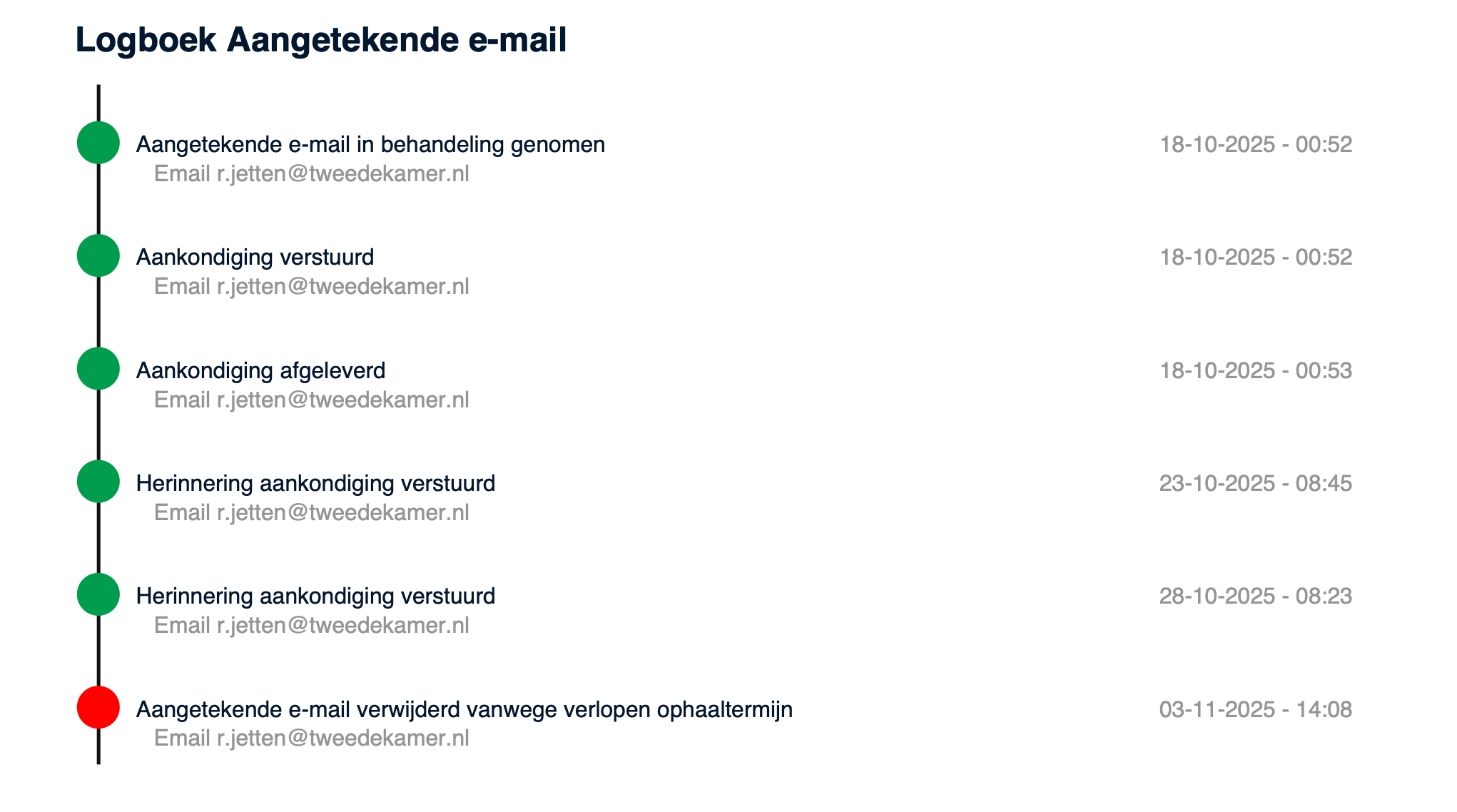
Because time is running out and the journalistic relevance is fading to zero, as well as the four-week objection period almost expiring (after which an appeal to the Dispute Resolution Committee becomes inadmissible), I send the same letter to the rest of the D66 parliamentary group on October 24, 2026. This registered email also expires after two reminders, this time on November 5, 2025. Except for one Member of Parliament:
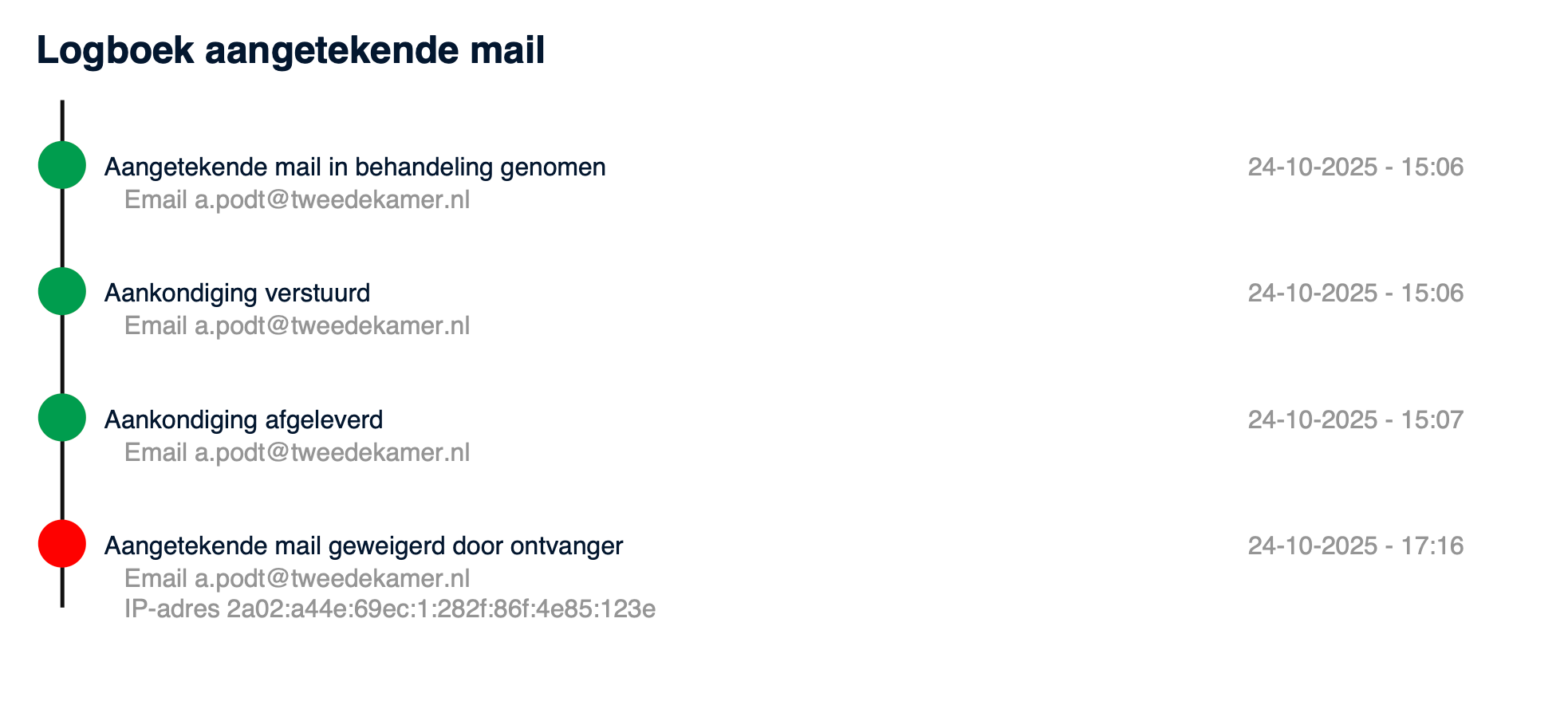
Fortunately, because of this, I know that the parliamentary group did at least see the email, and that it therefore did not end up in a spam filter. Why the entire D66 parliamentary group—two members of which are currently Prime Minister and Minister of Social Affairs and Employment (SZW)—would then refuse to accept a registered letter that they knew, or at least ought to have known, concerned a weighty matter, remains an unsolved mystery to this day. The only reason I do not open letters myself is because I know in advance what the contents will be.
One day before the elections of October 29, 2025, I receive an email from Sabine Andeweg, in response to my second email to the National Office containing the additional questions and the repeated request to provide the original text of the congress rules. In it, she repeats the story about the house rules and speaks of a vague, arbitrariness-prone criterion by which permission to hand out flyers at a D66 congress is granted. The original text of the congress rule is not included. There are, however, new peculiarities:
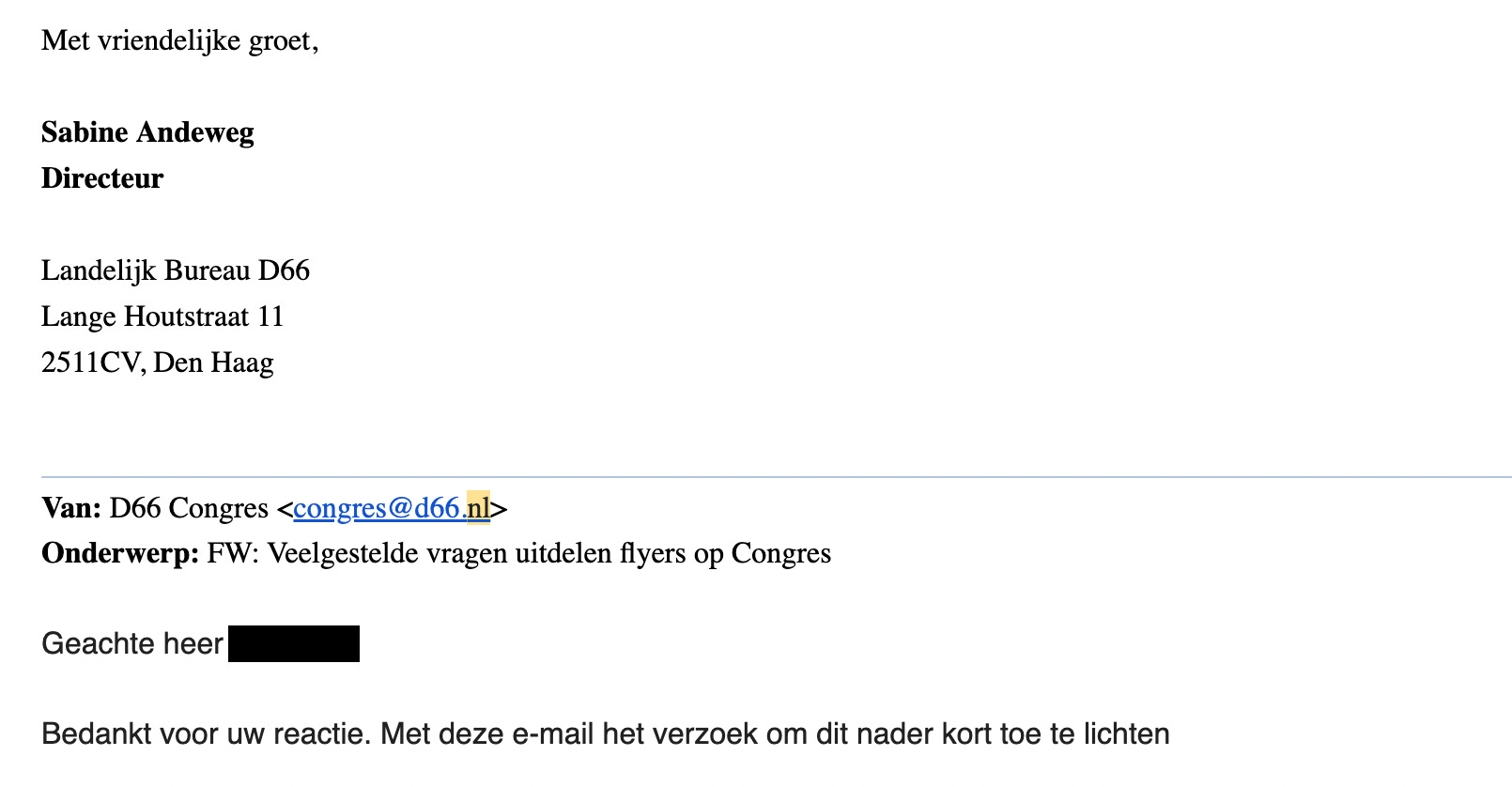
Sabine Andeweg responded to an email forwarded to her, my email to the Event Manager from October 13, 2025. When forwarding messages, most email clients append the previous messages, creating a thread. These also include the so-called “headers,” such as From, To, Date, CC, and Subject. Normally, that looks like this:
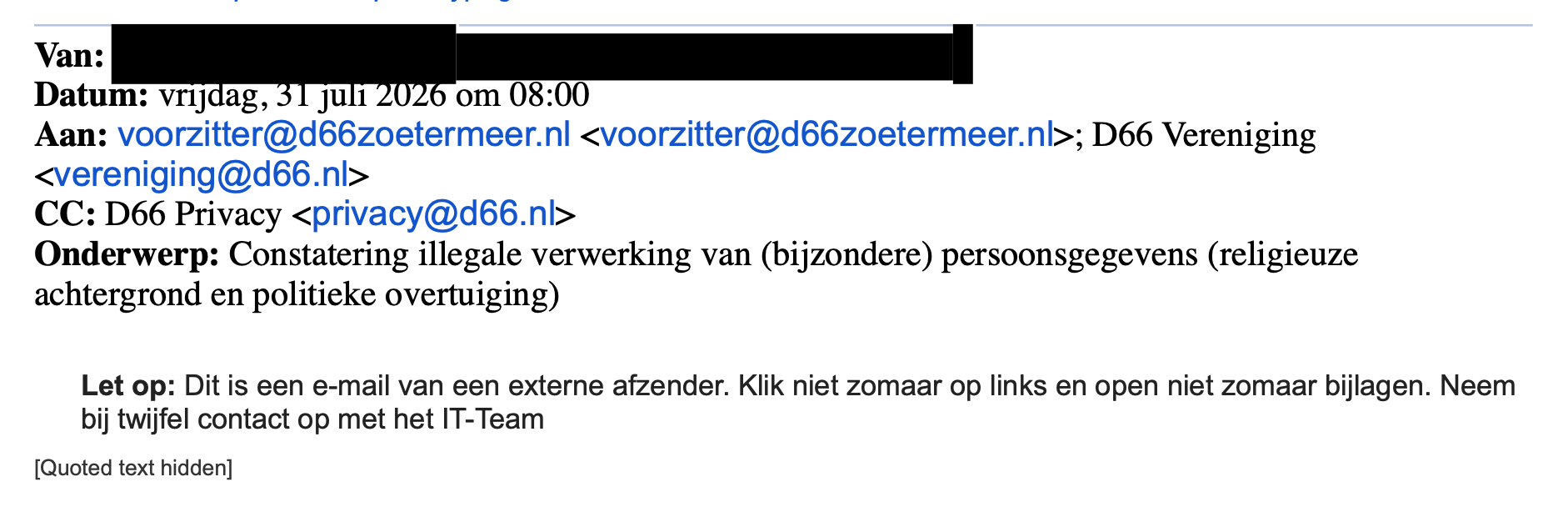
However, in Sabine Andeweg’s email dated October 28, 2025, the ‘To’ and ‘Date’ headers are missing. This means that she intentionally removed those headers from the email thread. Why Sabine Andeweg did this remains a mystery to this day. Deeper in the email thread, I encounter another peculiarity:
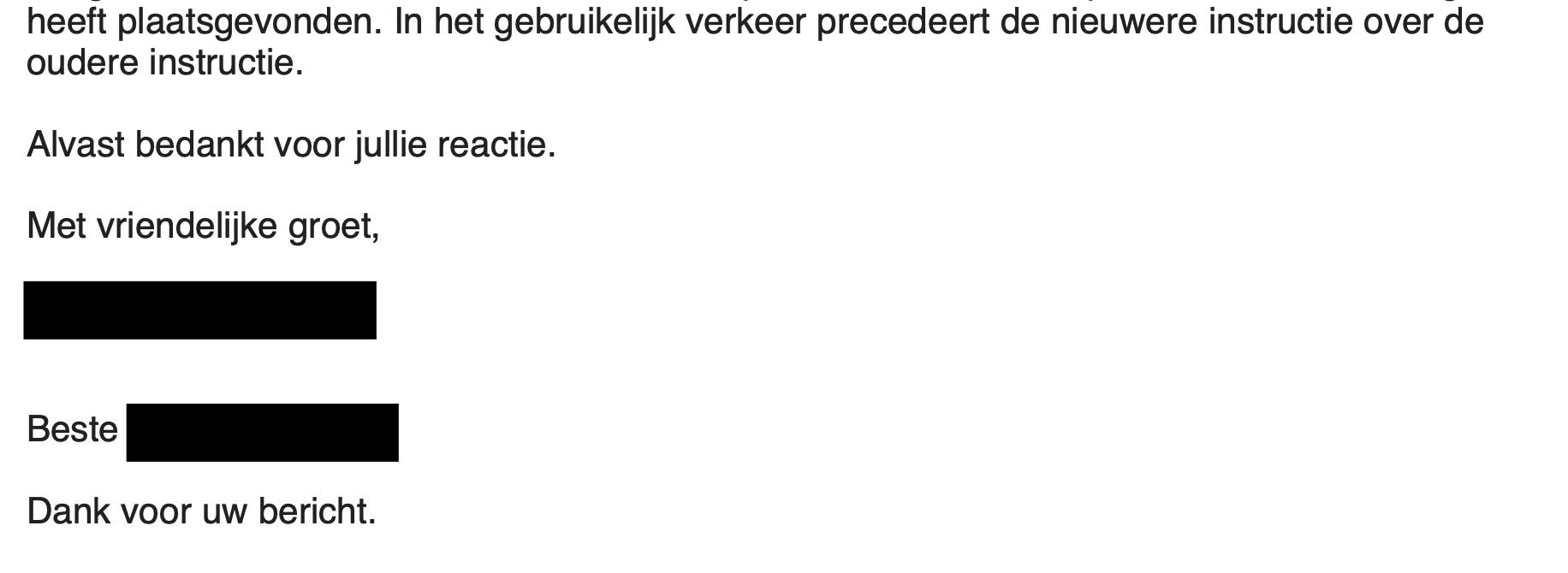
I do not reply to Sabine Andeweg’s email anymore. A potential journalistic route has by now been stalled to such an extent that a publication is no longer timely. The procedure at the Dispute Resolution Committee is technically still possible, but because the National Office refuses to provide the original, central piece of evidence, I have virtually no confidence in it. It would later turn out, incidentally, that Sabine Andeweg had also bcc’d her response to the National Board. Why the National Board would need to be informed about a seemingly trivial procedural issue remains an unsolved mystery to this day.
On October 29, 2025, D66 won the elections with a negligible margin of 30,000 votes more than the Party for Freedom. Only the Public Prosecution Service (OM) can determine what actually happened, as only the OM has the criminal investigative tools to do so. Perhaps it is all just a series of coincidences. But what is certain is that the fruits of all these coincidences are very sweet indeed. And what is also certain is that it was known within D66 that a scandal regarding the events at Congress 122 posed an existential PR risk. Anyway, I subsequently let the matter rest for a few months, only to pick it up again in the run-up to Congress 123.
What is certain is that on October 7, 2025, D66 began retroactively feigning a regulatory reality that did not exist at all on October 4. The page with rules had acquired an evidentiary purpose during Congress 122, insofar as it did not have one already, which D66 knew or ought to have known, and it deliberately manipulated this document to deprive a party with whom it had a dispute of evidence.
During those months, a number of interesting things also happened, although they are not relevant to the matter at hand. For comic relief, it might be amusing to mention that Nienke ‘s Gravemade appeared at the D66 Amsterdam Women’s Congress on January 30, 2026, and stated there that “bizarre” remarks can only be made and conceived by men, referring to the statement “I have never done it before, so I think I can do it,” which is (incorrectly) attributed to the fictional character Pippi Longstocking.
Spring offensive
On February 8, 2026, I sent a letter to the National Board of D66 focusing on just one central question:
Did the director of the National Office, Sabine Andeweg, forbid a member from handing out flyers at Congress 122 on her own initiative, or did she do this on the instructions of, or under the influence or advice of, third parties? If so, who? Based on your answer to this question, I will send you the subsequent questions.
I additionally wrote: “On October 24, 2025, it was made known to one of the confidential advisors that the affected member considers the actions of the director of the National Office at Congress 122 to be an unlawful act. In the member’s opinion, this ban has no regulatory basis, and the facts suggest that the distribution of the flyer was forbidden for content-related reasons. The member considers this to be political censorship.” I attached a 104-point statement of facts to the letter, describing the incident at Congress 122 and its aftermath, explicitly highlighting the physical intimidation and the retroactive alteration of the congress rules for Congress 122.
On February 19, 2026, eleven days later, the National Board sent a reply. In it, it states:
Your questions relate to responsibilities and procedures within our organization. In our email of October 28 last, the National Office already explained these points in detail. It is our conviction that the explanation and answers provided therein still apply fully and without reservation.
That was literally not my question. The board further repeated the story about the house rules that I had previously received from the Event Manager and Sabine Andeweg. What was new was an additional basis upon which the National Board justified its measure at Congress 122: there was allegedly a “fixed and established practice.” Apparently, neither the Event Manager nor Sabine Andeweg was aware of this fixed and established practice at Congress 122 yet. The National Board’s response made me understand why Pieter Omtzigt suffered a burnout, because this level of administrative gaslighting literally drains all your energy. I would not pick the case back up until June 2026.
From time-traveling house rules to the Public Prosecution Service
In its email dated February 19, 2026, the National Board finally did refer to house rules. They were hidden as a hyperlink in the email. I downloaded the file and checked the metadata. The pdf document was created on May 30, 2024. Via The Internet Archive, I then viewed the older versions of the D66 website, specifically the Statutes and regulations page. There, I could not establish that this document had ever been published (and therefore, legally speaking, could not have been in effect). Furthermore, the document contained nothing about requesting prior permission to inform the General Assembly of D66 via a flyer. There is, however, a passage regarding promotional activities:
D66 has a promotion policy. Without prior permission, no promotional activities may take place inside or outside.
Any reasonable person knows that “promotion” is understood to mean advertising a product, a book, an external foundation, or a commercial service. Or possibly a candidate for a D66 vote. Informing D66 members about a political topic does not qualify as a promotional activity. Moreover, I had by then also spoken to other D66 members who handed out flyers at D66 congresses, and they stated that they had not been required to ask for prior permission. Apparently, the National Board realized this as well, because on March 5, 2026, the Statutes and regulations page on the D66 website was updated with a new item: House rules for D66 events and gatherings. According to the metadata, that pdf document turned out to have been created on that very same day, by the Event Manager. The content of the pdf document was largely the same as the earlier version from May 30, 2024, except that a remarkable provision had been added:
D66 has a promotion policy. Without prior permission, no promotional activities may take place inside or outside. Flyers distributed during the events must be coordinated with the national office at least 48 hours in advance.
On October 13, 2025, the D66 Event Manager claimed that he had made the page with rules for Congress 122 “consistent” with house rules that he himself would not create until March 5, 2026! Nothing is surprising anymore within D66, since house rules can apparently time travel.
When I sent a formal reminder to the National Board on June 16, 2026, regarding the questions I had asked by email on February 8, I did not yet know that the house rules had been fabricated on March 5. That discovery occurred a few weeks later, which led to a series of formal demands and notices of default being served to the National Board. In one of those notices of default, I wrote to each member of the board personally, including an offer to discreetly distance themselves from the course of events in order to shield themselves from administrative responsibility. None of them responded to this. Since the National Board completely failed to respond substantively, I argued extensively by email on July 19, 2026, that the National Board was maintaining against its better judgment that the decision of the director of the National Office was lawful.
In the meantime, I had gained deeper technical insight into the documents that formed the basis of the pages containing the congress rules. I therefore wrote in that same letter that the facts gave the appearance of forgery, unambiguously stating my intention to submit this to the Public Prosecution Service. As a final gesture, I therefore issued a reasonable ultimatum “in the interest of de-escalation”:
You are [...] in default towards me under civil and association law. For the settlement of our internal and civil-law relations, and to prevent further (civil) escalation, I am offering the National Board, by means of this letter, one final opportunity to honor the following within five working days:
To demonstrate that, at Congress 122, there were house rules or other regulations in effect stating that prior permission was required to distribute flyers at a D66 congress, and that Ms. Andeweg was entitled based on these rules to prohibit me from doing so, or to provide a written statement in which you unconditionally acknowledge that Ms. Andeweg acted unlawfully towards me at Congress 122.
To disclose in writing and unambiguously which yet-to-be-identified third parties Ms. Andeweg went to consult with, as I had already requested on February 8, 2026, and also to disclose the nature of this consultation and how it influenced Ms. Andeweg’s decision-making.
To provide the text of the page containing the rules for Congress 122, exactly as it read there on October 4, 2025.
Does it even need to be mentioned that no substantive response was forthcoming? On July 21, 2026, I received an email back from the National Board. In it, it stated that my presence at Congress 122 had been unlawful, that I allegedly “had neither the right nor the interest to complain,” and that the correspondence about Congress 122 “burdens the association in a manner that it cannot reasonably be expected to endure.” The latter is almost a word-for-word paraphrase of the article in the civil code that allows for the unilateral termination of a member’s membership—a thinly veiled threat of expulsion. Against my better judgment, I formally demanded the National Board to distance itself from this position, to which no further response was received.
The National Board also seized upon my effort at de-escalation to unilaterally summon me for a conversation at the National Office, which would be about “what expectations the association may mutually have regarding membership and functioning within the association.” When asked, the board would not disclose who this conversation will be with, what their mandate is, and what the concrete agenda items are. It did, however, let it be known that “membership in the association is a mutually voluntary matter, bounded by applicable regulations and governed by reasonableness and fairness.” Reasonableness and fairness. When does this conversation take place? Prinsjesdag (Prince’s Day).
Thus, on Friday, July 24, 2026, at 12:00 PM, an interviewing officer of the The Hague Police Unit heard a person, who declared that the D66 National Board had provided de facto leadership to the commission of forgery by the director of the D66 National Office, and had apparently attempted, through its threats, to restrict this person’s freedom to make a statement—and this person signed the official report of the criminal complaint on Friday, July 24, 2026, at 5:11 PM.
Epilogue
By now, the flyer incident at Congress 122 has become an open secret within D66. I have written to multiple bodies—including the Amsterdam D66 faction and, accidentally, two aldermen, Member of Parliament Marieke Vellinga-Beemsterboer, and the board of the Els Borst Network—requesting them to take a stance on this or to open a dialogue. I have also systematically provided the entire network of confidential advisors with copies of the correspondence with the National Board. There is also a Committee for Integrity Investigations, but I did not write to them, because according to its own regulations, it lacks jurisdiction if employees of the National Office are involved.
They have all failed to respond. The chair of the Els Borst Network, however, did find it appropriate to demand via LinkedIn that I remove “candidate chair Els Borst Network” from my job description, because my publications were allegedly in conflict with the convictions of the Els Borst Network. What those convictions supposedly were, she did not say. Therefore, my job description is now “former candidate chair Els Borst Network.” Incidentally, the National Board and the board of the Els Borst Network also did not respond when I informed them in writing of threats related to my activities within D66:
Keep that same energy. I am going to run into you. Your whore mother. You really have a serious problem with me. I am going to stomp the teeth out of your mouth. I know you are active with D66 in The Hague. I don’t give a shit if I go to jail for it, I will just kick you right into the intensive care unit. You have been warned, you dirty fucking midget. I am going to do some investigating [into which D66 meetings you attend] and I swear on everything I hold dear that you will be picking your teeth up off the floor and that you will end up in the intensive care unit. Keep that same energy the moment I stand in front of your face. I swear on my mother’s death, one day I will stand in front of your face. I will keep stomping on your head and I don’t care if [the police] are standing right there. I am crazy in the head.
I received this threat because when he said that his “honor and pride” resided in his female relatives, I asked him why his “honor and pride” were then dependent on what his mother does with her vagina. Later, a GDPR access request would reveal that this letter had magically disappeared. Anyway, why I had the illusion that I would receive a response this time remains a mystery thus far.
I also tried to initiate a procedure with the Dispute Resolution Committee to appeal the ignoring of my ultimatum dated July 19, 2026. It ruled that the appeal was inadmissible, because the incident took place at Congress 122 and the time limit for filing an appeal had therefore long since expired. After I unambiguously made it clear that it was an appeal against the National Board’s decision not to meet my lawful demands, the Dispute Resolution Committee stopped responding altogether. The absolute deadline for this expired on August 28, 2026, at 5:00 PM.
I have since spoken with many D66 members about the incident at Congress 122. Why do I document everything so obsessively, you might ask? Because otherwise, I would have been left empty-handed and unable to prove absolutely anything. The Internet Archive does not lie. The only one lying is the D66 National Board. Then they say: “You are right, Izzy, but surely this isn’t something you want to concern yourself with?” It is indeed not something I want to concern myself with: what I actually want to concern myself with is stated at the beginning of this longread. But it is too easy to say that someone should just swallow it, when you are not the one who has to do the swallowing.
If you yourself are not the one who, under physical intimidation based on a measure invented on the spot, is restricted in pursuing their political goals, then that is very easy. And if you yourself are not the one who moves among free individuals, who happen to have ancestors born abroad, and whose desire for freedom is answered exclusively with violence and exclusion. That is a price that too many people in our country have to pay daily for their freedom, when they refuse to submit to the faith their parents chose for them, or the dictates of the cozy community of which they were made a part unasked. And Rayaan al-Najjar, who did not bow to the faith her executioners wanted to impose on her, paid for that with her life.
If fourteen-year-old girls in a pink tracksuit do not yield to death threats, then I will certainly not yield to the usurpers who call themselves the National Board of D66. The political and legal avenues within D66 are now exhausted. Therefore, it is now up to the members to pass judgment on these facts. The National Board will provide clarification regarding the events at Congress 122, and if the members of D66 do not do so, then the fist of freedom will compel it to do so through a civil procedure.
It remains to be said that it is clear that the National Board intends to expel me on Prince’s Day (Prinsjesdag). The National Board cannot expel me, however, because as of the date of this publication, I declare it unauthorized, since a board that demonstrably lies and creates the appearance of criminal activities can no longer be authorized or competent to make decisions on behalf of D66, noble house of the Enlightenment, party of democracy and the rule of law, legacy of Hans van Mierlo and Els Borst.
Izz ad-Din Ruhulessin
August 29, 2026